
It was none other than Ludwig Mies van der Rohe, the creator of the Barcelona Pavillion, (which is often described as one of the most beautiful 20th century buildings), who coined the phrase ‘less is more’. Van der Rohe could have been talking about perforated aluminium sheet!
What other material simultaneously provides so many design opportunities to combine its inherent strength to weight ratio and corrosion resistant qualities with a widely appreciated aesthetic appeal? By virtue of these outstanding attributes, perforated aluminium sheet is often incorporated into many architectural components as the primary element. These products would include balustrade panels, bar/counter fascias, ceiling panels, column casings, radiator/vent covers, wall cladding and so on.
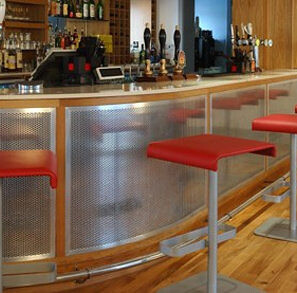
It is often desirable to custom make perforated aluminium panels rather than fabricate from stock size sheets. This way the specifier retains much greater design flexibility by being able to incorporate plain borders and other unpunched areas, as well as, cut outs for lighting, vent ducts, etc. With the majority of round hole patterns being arranged on a 60 degree triangular pitch the plain borders are normally lost once pre-punched sheets are cut to size. Unless covered with a safety edge or hidden by some other component the resulting raw edge is a health and safety no no.
Installing Gooding Aluminium Radiator or Vent Covers – RC2
Our modern 5 Star Processing Service accurately and rapidly fabricates Aluminium Radiator & Vent Covers to meet your precise specification.
Our modern 5 Star Processing Service accurately and rapidly fabricates architectural aluminium products to meet your precise requirements.
Some of our most popular items; Balustrade Panels, Column Casings, Suspended Ceiling Trays, Wall Panels etc., have been collated into easy to understand formats aided by useful checklists, clearly illustrated drawings and assembly/fitting videos.
You can browse our fabricated aluminium products by clicking here.
Installing Gooding Aluminium Radiator or Vent Covers – RC1
Our modern 5 Star Processing Service accurately and rapidly fabricates Aluminium Radiator & Vent Covers to meet your precise specification.
Aluminium is incredible stuff! It is a unique metal with a positive image that naturally appeals to the professional specifier and installer.
This incredibly versatile material, when combined with its alloys, can be folded, formed, machined or worked using a wide range of processes.
Thanks to these excellent material properties, aluminium has become widely used within an extensive variety of architectural and related applications.
Stair nosings – Regulations to consider for architects and specifiers
According to building regulations stairs, ladders and ramps have to be designed, constructed and installed in a way that is safe for people moving between different levels in or about the building. Gooding Aluminium therefore takes a deeper look at regulations to help ensure specifiers are compliant when installing aluminium stair nosings.
 Size
Size
According to Building Regulations (K&M), BS8300 and BS9266, the recommended dimension of a stair nosing should measure between 50-65mm and the riser 30-55mm. This ensures there is a large enough ‘band’ on the nose of the step.
Colour
Building Regs (K&M), BS8300 and BS9266 explain that the colour of the Stair Nosing is required to differ from that of the floor covering.
Every colour has a Light Reflectance Value (LRV) of between 0 (Black) and 100 (White). The documents indicate that there should be at least 30 points difference between the Stair Nosing LRV and that of the floor covering, e.g. If the floor covering has a LRV of 50, then the Stair Nosing should have a LRV of between 0-20 or 80-100. This helps create the ‘ladder effect’.
Slip resistance
The tread material used in a Stair Nosing is important for the safety and performance of a stairway. There are two recommended tests that can be carried out to determine the slip resistance of a flooring material.
The pendulum test (PTV) and a surface micro roughness measurement (Rz). Either of these can be used to give an indication of the slip resistance of a material, although the Pendulum method is limited in so far as it cannot be used to test material on site.
A guide to specifying bespoke aluminium
Aluminium is a highly versatile, lightweight and strong material and can be worked using a variety of metalworking techniques.
An increasing number of architectural projects involve the specification of worked aluminium. To assist with this process and to ensure the product realisation meets your expectation we would like to share with you some important design considerations.
Bespoke working involves making items to specifier requirement on a one-off type basis. Job specific – quantities, sizes, shapes, radii, fixing details etc., are all incorporated into the finished item.
With each unique specification there is a first time for everything. It is always possible that unexpected developments can arise.
Practical consideration in terms of material performance and / or machine capabilities can therefore cause some variation to the originally specified requirements. Tolerances with specially made items are generally looser than those for manufactured parts.
Component size can have a critical bearing on overall job cost effectiveness. Closely compare preferred size requirements to standard stock configurations. Small dimensional adjustments are often possible and can achieve significant financial savings.
Corner radii on bent / formed items are determined by a combination of material thickness and alloy grade. A radius on the outside corner, of up to twice the metal thickness, is possible.
Countersunk holes cannot be provided on material thinner than 1.2mm.
Crazing of anodic coatings will occur due to mechanical influences such as forming or bending. Anodic crazing by cold deformations of all kinds can be avoided by ensuring that these precede the anodising process.
Dimensional tolerances apply to all bespoke products.
Grain structure on brushed surfaces is best designed to run vertically, this minimises dirt entrapment and eases cleaning. Mill and anodised surface finishes can clearly show the metal grain and it is therefore preferable to avoid adjacent component surfaces with conflicting grain direction.
Insulate at connections with other metals, for maximum durability.